Breach of fiduciary duty is a term often associated with business. When we hear of these cases in the news they often include board members, financial or legal professionals, or other corporate entities.
Businesses are not the only things affected by fiduciary duty though. Marriages are as well.
A breach of fiduciary duty can happen during a marriage or divorce proceedings. The consequences can be severe, just as they are with corporations.
California Family Code
Various sections of the California Family Code cover different aspects of fiduciary duty and the consequences for breaching it. The codes all support the same belief: spouses have the highest level of fiduciary duty because their relationship is based on the highest level of honesty and trust.
The legal assumption is that people entering a marriage expect their spouse to be more honest and trustworthy with them than they are in any other relationship. Because of this, there is a legal expectation that no spouse will take financial advantage of the other.
Just as business partners look out for the financial well-being of the entire business, it is expected that married couples will look out for the well-being of their marital community. The law expects married people to act as business partners for all major financial decisions.

Fiduciary Duty Between Spouses
Fiduciary duty in marriage is straightforward. Couples have a duty to make financial decisions that are in the best interest of their family unit as a whole.
Sometimes a decision is made that might benefit one person more than another. That can happen, but at the very least there is a legal expectation that a spouse will not make a financial decision that benefits them to the detriment of their partner.
At the center of fiduciary duty is the idea of community property.
Community Property
Community property in a marriage is very simple. It is any asset or debt you acquired while married or purchased with money you earned while married.
In the case of a divorce, community property is typically divided in half, regardless of who paid for it or who owns it.

Community Property and Fiduciary Duty
Community property is tied closely to fiduciary duty. Because fiduciary duty assumes that couples make financial decisions together, everything is considered community property unless both spouses agree that an asset is separate property.
Fiduciary duty usually means that no financial decision is made in secret. Because of this, it is legally impossible (at least, without consequences) to have separate property that one spouse does not know about. It is either community property that both partners are aware of or it is separate property that both partners are aware of.
If you have a separate account, vehicle, business, house, or any other asset or debt that your spouse does not know about, you are breaching your fiduciary duty.
What Counts as a Breach?
There are many ways that someone can commit a breach of fiduciary duty during their marriage.
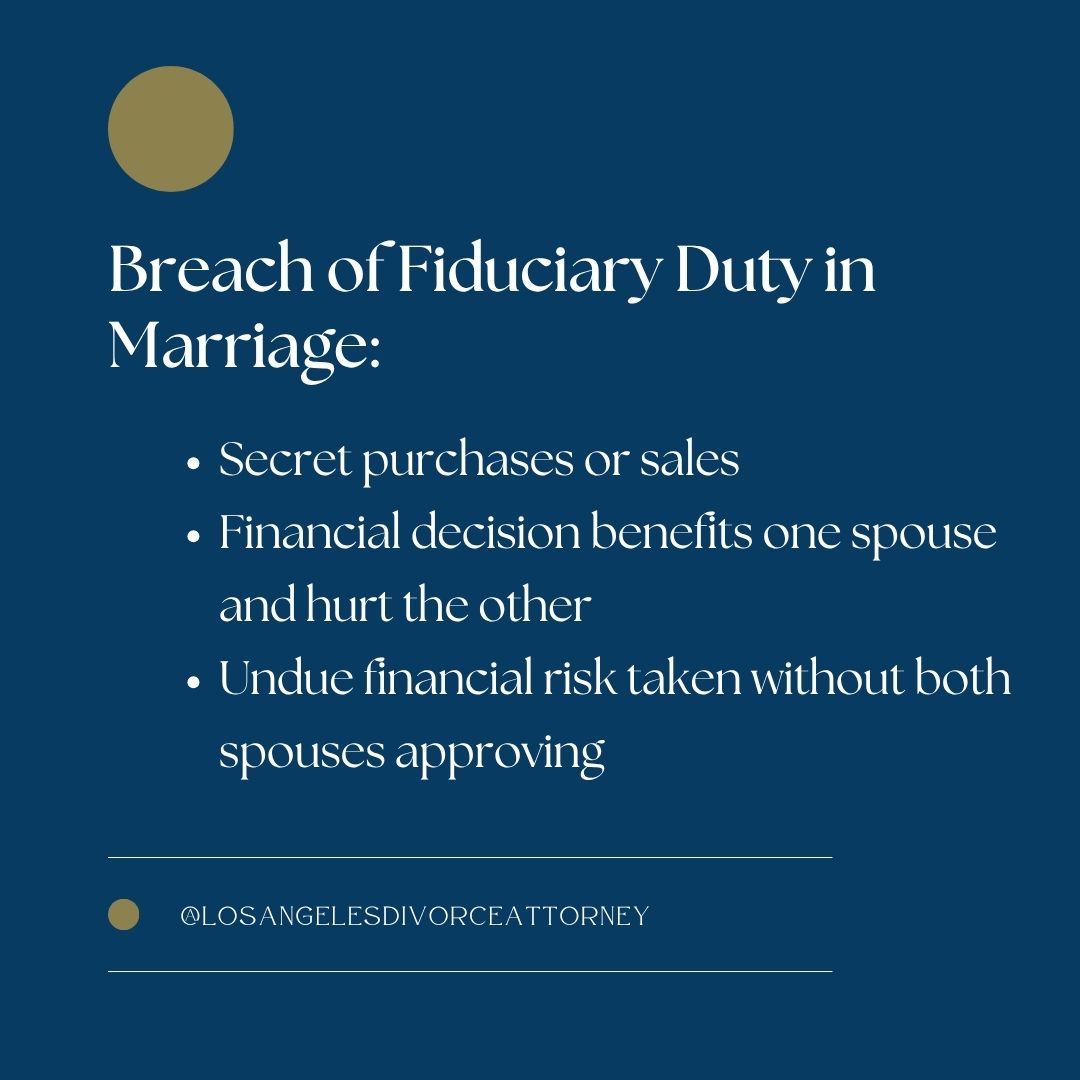
Most breaches involve these common offenses, and sometimes more than one:
- A purchase or sale is made during a marriage that will hurt one spouse and benefit another.
- A purchase or sale is made in secret.
- A purchase or sale hurt both partners, but only one partner agreed to the decision.
The following sections outline common breaches.
Community Property
Anytime community property purchases or sales happen without the other spouse knowing, there is a risk of a breach of fiduciary duty.
Intention
The law doesn’t set a dollar limit on community property. It also doesn’t specify how much money needs to be spent in secret to be considered a breach. Theoretically, something as small as a mixing bowl is considered community property. So can you even make a Target run without clearing it with your spouse?
Intention plays a large role in deciding if something is a breach. It is expected that spouses will make day-to-day decisions without each other. It is also expected that spouses will make purchases from time to time without consulting each other.
One partner might regularly be in charge of grocery purchases, while the other is responsible for purchasing household items. You aren’t required to get approval for every item you ever buy. As long as your financial decisions are reasonable, not benefiting you to the detriment of your family, and there is no pattern of malice, you are living within the law.

Small Community Property Assets
Typically only large community property purchases or sales will trigger accusations of fiduciary neglect. There are situations where small sales can be an issue though.
Legally, one spouse cannot sell or give away community property without the consent of the other spouse. This is true even for small things such as clothes, dishes, or furniture. While it isn’t rare for one spouse to do spring cleaning or organize their children’s clothing without the other, it can be a problem if it is a form of financial abuse.
If one spouse is regularly selling small community property items to benefit themself while their family is still using the items, it is a problem. This is often seen in relationships where one spouse sells items to cover a gambling debt or to buy illegal substances.
Selling family members’ items is considered financial abuse.
Business
Buying or selling a business without the knowledge of your spouse is a cut-and-dried breach of fiduciary duty. This is true whether the business is owned by both partners or not. Because both partners can benefit or be hurt by a business, both partners need to be a part of the buying or selling process.
Investments
Investments are another area that can cause fiduciary problems within a marriage. It is common for individuals to invest individually in marriage. Many investment options like 401Ks and other retirement programs are solo investment opportunities. Investing alone is not an issue. Investing in secret and to the detriment of one spouse is.
One way investments have been tied to a breach of fiduciary duty is when they are done in secret so only one partner benefits. This is commonly seen when a partner uses an inheritance or pre-marital money to invest.
Because money in an account before marriage or an inheritance isn’t considered community property, people can spend it how they like. The breach comes from the fact that Partner A knew about a financial opportunity that could have benefited Partner B and they didn’t offer to use community property money and benefit the community. This is seen as Partner A intentionally looking out for their needs over the marital community.
If there was enough community property money to invest and Spouse B wasn’t given an opportunity to invest, then Spouse A is guilty of a breach of fiduciary duty.
Investments are considered community property and should be treated as such during a marriage.

Debt
Acquiring debt without the approval of both spouses is a common breach of fiduciary duty. This can be debt from a property purchase, credit card debt, or even student loan debt.
Any line of credit, even if taken out in only one spouse’s name, should be common knowledge of both partners.
Refusing Access to Finances
Spouses can own separate property in a marriage, but each spouse is legally entitled to see the accounting and statements for individual property.
California Family Code clearly states that spouses need to have access to any separate or marital property accounts and they are entitled to make copies of any accounts or statements. They cannot be denied financial knowledge or the ability to have their own copies.
Whether someone is hiding a community property or a separate account from their other spouse, it is illegal. You cannot have any hidden accounts, assets, or debts.
This is true of business accounts as well. Even if a spouse is not an owner of the business, they have to be allowed to see the books.

Intentional Mismanagement
Sometimes people believe they will benefit if their business fails or if something else financially falls through.
If one spouse can prove that the other spouse intentionally mismanaged an asset or bungled a sale, they can be found guilty of breaching their financial duty.
Accidents
A breach is a breach, even if it is accidental. Courts can consider accidents as negligence, and they will be treated as such. However, typically, the standard is gross negligence, rather than simply a matter of not paying close enough attention to investments. Still, many couples have spent far too much money in court proving or disproving the difference between negligence and gross negligence. Don’t be one of them.
Good-Faith Effort
The only exception to a breach of fiduciary duty is if a good-faith effort was made to follow laws and benefit the community. Financial mistakes happen every day. As long as one spouse can prove that they made every effort to benefit the community and that their partner knew what was happening all along, they are not in breach.
Businesses can fail, a sale can be disrupted, or a bad investment can be made. These things happen. As long as there was transparency and no intentional mistakes to purposefully worsen a financial situation were made, you will not be charged with a breach of fiduciary duty.

Breach of Fiduciary Duty During Divorce Proceedings
During divorce proceedings, both parties are expected to be financially transparent even if they weren’t during the marriage.
Financial Disclosure Statements
If you are filing for divorce, even an uncontested divorce, you will have to provide financial disclosure statements. The only way to bypass this is if one party discloses and the divorce happens through the default of the other party, in which case the filing party can ask the court to waive the non-filing party’s duty to disclose.
You cannot hide any debts or assets in your financial disclosure. The most common breach of fiduciary duty during a divorce proceeding happens when a partner tries to leave assets off their financial disclosure.
Do You Have a Fiduciary Duty After Divorce?
If you have finalized a divorce, you could still have a fiduciary duty to your ex-spouse.
A fiduciary duty lasts from the day of marriage until all community property assets have been separated. If the assets are not physically divided until after the divorce is finalized, there is still a fiduciary duty after marriage until all assets are divided as laid out in the divorce decree.

Legal Consequences of a Breach of Fiduciary Duty
Most cases of breached fiduciary duty happen during divorce proceedings. It is possible to sue someone you plan to remain married to, though. In either situation, the consequences are similar.
Loss or Division of Assets
Because a breach of fiduciary duty is a financial crime, consequences are often monetary. The punishment is usually in proportion to the severity of the crime as well. A smaller breach will have a smaller financial penalty than a larger breach.
A common consequence is a spouse will be assigned ownership of any assets in the case. Typically, a spouse will be assigned 50 percent ownership.
When a divorcing spouse intentionally hides assets, they can be forced to give up 100% ownership of the hidden assets. In cases where there has been intentional fraud, malice, or oppression, the other party can receive total ownership as well. The punishments are steep to prevent people from even attempting to hide income or property during divorce proceedings.
In most cases, the fiduciary victim will also be entitled to a reimbursement of their attorney’s fees.

Statute of Limitations
While a breach of fiduciary duty is taken seriously by the court system, there is a three-year statute of limitations. This means you cannot sue a spouse if their financially neglectful actions are over three years old.
If you believe you are the victim of a financial manipulation or other breach, reach out to an attorney sooner rather than later.
Do You Have a Breach of Fiduciary Duty Case?
A breach of fiduciary duty during a marriage or divorce proceedings is a serious offense. Offenses can be catastrophic to the offended spouse. There is court-ordered financial compensation available, though.
Contact our experienced legal team to talk about your specific situation and find out what you could be entitled to.